A continuity plan becomes concrete when it names an essential purchase: transportation home, ordinary groceries, or another immediate household need. “Have a backup” is too vague if the backup depends on the same unavailable phone, power supply, merchant, or service. The useful question is which dependency could fail and what practical alternative is already legitimate and available to you.
This article does not recommend a particular card, account, borrowing product, or amount of cash. It does not guarantee acceptance or tell you to move money. The exercise is to examine a specific need and the conditions of the options you already have, then identify any unanswered question before relying on an option during a difficult moment.
Define the need and the setting
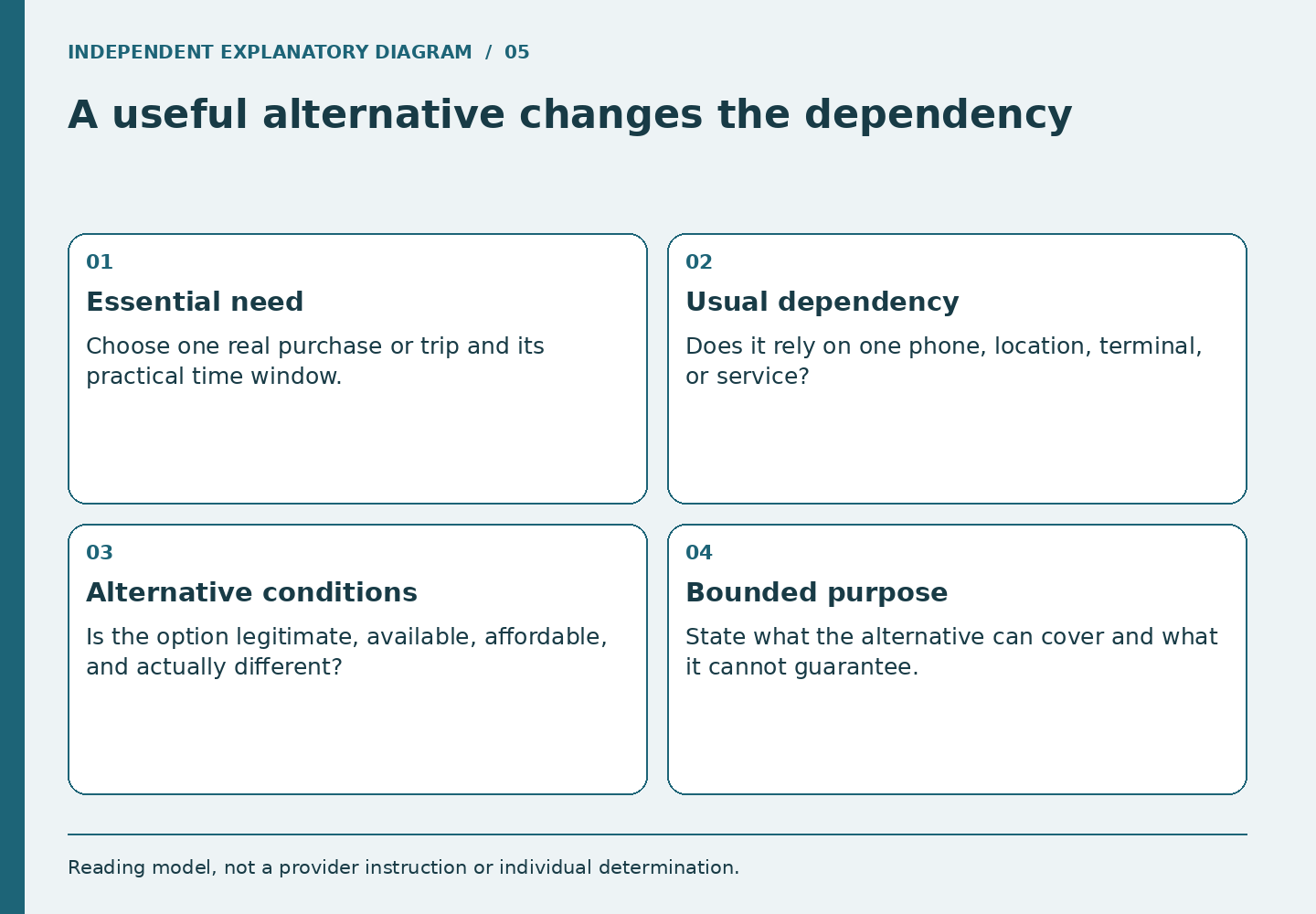
Choose one ordinary scenario. Where would the purchase occur? Is it tied to a particular time or location? What makes it essential? A ride home after a late shift has different practical constraints from a household purchase you can make earlier. Begin with those differences rather than treating every contingency as an identical financial problem.
List the dependencies of the usual method: a functioning merchant terminal, a usable card, accessible funds, or a working device if the method needs one. Do not assume the provider’s general product description settles the merchant’s actual acceptance policy or every program limit. Verify relevant conditions with the organization that controls them when the answer would change the plan.
Look for a genuinely different dependency
In a fictional example, a household’s usual purchase method depends on a phone and one nearby location. A proposed alternative that uses the same phone at the same location may not solve a phone or local power problem. A different time, a different accessible location, or a permitted method already available to the household may deserve examination. Whether any option is suitable depends on its actual conditions.
Ready.gov notes that extended power outages can disrupt ATMs and payment terminals. That supports checking dependencies, not assuming that every outage requires a large withdrawal or that cash is risk-free. If you consider any preparation involving money, account for security, affordability, access, and applicable terms. Do not create a financial burden in the name of preparing for every possible interruption.
Set a modest boundary for the plan
Choose the period and need the contingency is meant to cover. A plan for getting home tonight is not a full disaster financial plan. A household supplies plan is not an assurance that all merchants remain open. Clear boundaries make it easier to judge whether the option actually helps and prevent a small exercise from expanding into expensive or unnecessary changes.
If the alternative requires permission, registration, a new agreement, or a fee, that requirement belongs in the plan as unresolved until properly handled. Do not count an imagined option as available. Likewise, do not assume another adult’s card, vehicle, or money is part of your backup without their explicit agreement and the necessary authority.
Review the plan after a relevant change in location, work schedule, or ordinary payment routine. You can rehearse it by reading the scenario and identifying the next step; no live purchase is required. The useful outcome is one proportionate, verified alternative for a real household need, with its limitations visible, rather than a collection of backups that all rely on the same thing.
Sources and reading boundaries
Sources checked October 7, 2026. This is a review date, not a policy effective date or an account test.
- Ready.gov: Resolve to be Ready: Emergency-readiness guidance notes that extended power outages can affect ATMs and payment terminals and recommends preparing supplies and backup charging. Official indexed text used; direct access to related power-outages and financial-preparedness pages returned 403. No claim of present outage, local safety conditions, or universal cash requirement. Review basis: Official search-index text reviewed; page marked last updated December 30, 2024.
- CFPB: Planning for life events and large purchases: General value of naming an upcoming event, timeframe, and associated costs. 2018 educational worksheet. No credit recommendation, cost estimate, inflation assumption, or savings target adopted. Review basis: Official PDF text reviewed, three pages.